
Patient Overview
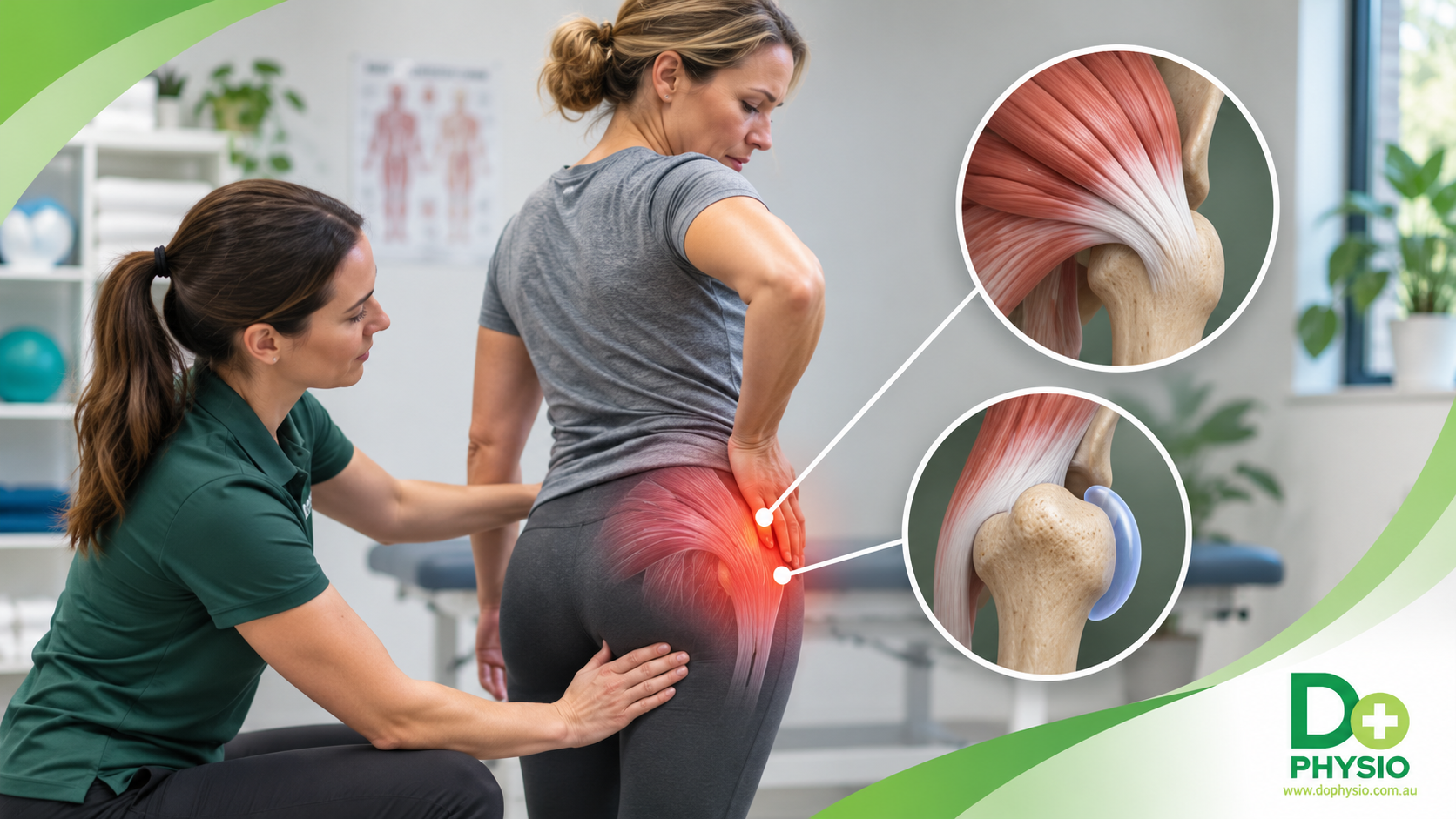
Pain on the outside of your hip, particularly when lying on your side or climbing stairs, may involve the gluteal tendons. Adjusting painful activities and gradually strengthening the hip can help many people.
Clinical and Academic Discussion
Pain over the outside of the hip is often labelled trochanteric bursitis. However, the gluteus medius and minimus tendons are frequently involved. Greater trochanteric pain syndrome (GTPS) is an umbrella term that includes tendon and bursal disorders in this region. Recognising the contribution of the tendons can influence the rehabilitation strategy.
The role of the gluteal tendons
The gluteus medius and minimus help stabilise the pelvis during single-leg support, including walking and stair climbing. Their tendons attach around the greater trochanter. Repeated or excessive loading, particularly when combined with compression against the underlying bone, can contribute to symptoms in susceptible individuals.
Why does sleeping on your side hurt?
Direct pressure over the greater trochanter can aggravate lateral hip pain. Hip adduction, such as crossing the legs or letting the upper knee drop across the body during side-lying, can also increase compression of the lateral hip tendons. These mechanisms are relevant to load management, although individual responses vary.
How is GTPS assessed?
Local tenderness, pain during resisted hip abduction and symptom reproduction during single-leg loading are useful findings. The assessment should also include hip joint mobility, gait and the lumbar spine. Groin-dominant pain with restricted hip rotation may suggest intra-articular pathology, whereas radiating symptoms or neurological findings may point towards a spinal contribution. Imaging is sometimes useful but should be interpreted in context.
Exercise versus corticosteroid injection: the evidence
In a randomised trial, Mellor et al. (2018) compared education plus exercise, a corticosteroid injection and a wait-and-see strategy for gluteal tendinopathy. Education plus exercise produced better global improvement at eight weeks than either comparison and better global improvement than injection at 52 weeks. At 52 weeks, pain intensity did not differ significantly between education plus exercise and injection. The results support a structured rehabilitation approach, particularly for perceived overall improvement.
What does rehabilitation involve?
Early management may involve modifying aggravating positions, using a pillow between the knees during side-lying and reducing sudden increases in walking or stair volume. Progressive hip abductor strengthening and functional loading are then introduced according to tolerance. Complete rest is generally not the long-term goal. Exercise progression should consider the response during the activity and the following day.
When should you seek further assessment?
Persistent symptoms, marked weakness or significant deterioration warrant review. Inability to bear weight after a fall, or acute severe hip pain with fever or systemic illness, requires urgent medical assessment.
References
Mellor et al. (2018). Education plus exercise versus corticosteroid injection use versus a wait and see approach on global outcome and pain from gluteal tendinopathy. BMJ, 361, k1662. Full text; PubMed; DOI.
General educational information only. Individual assessment is recommended.
Literature and clinical content updated 25 November 2026. This is an educational resource, not a substitute for individual clinical assessment.