
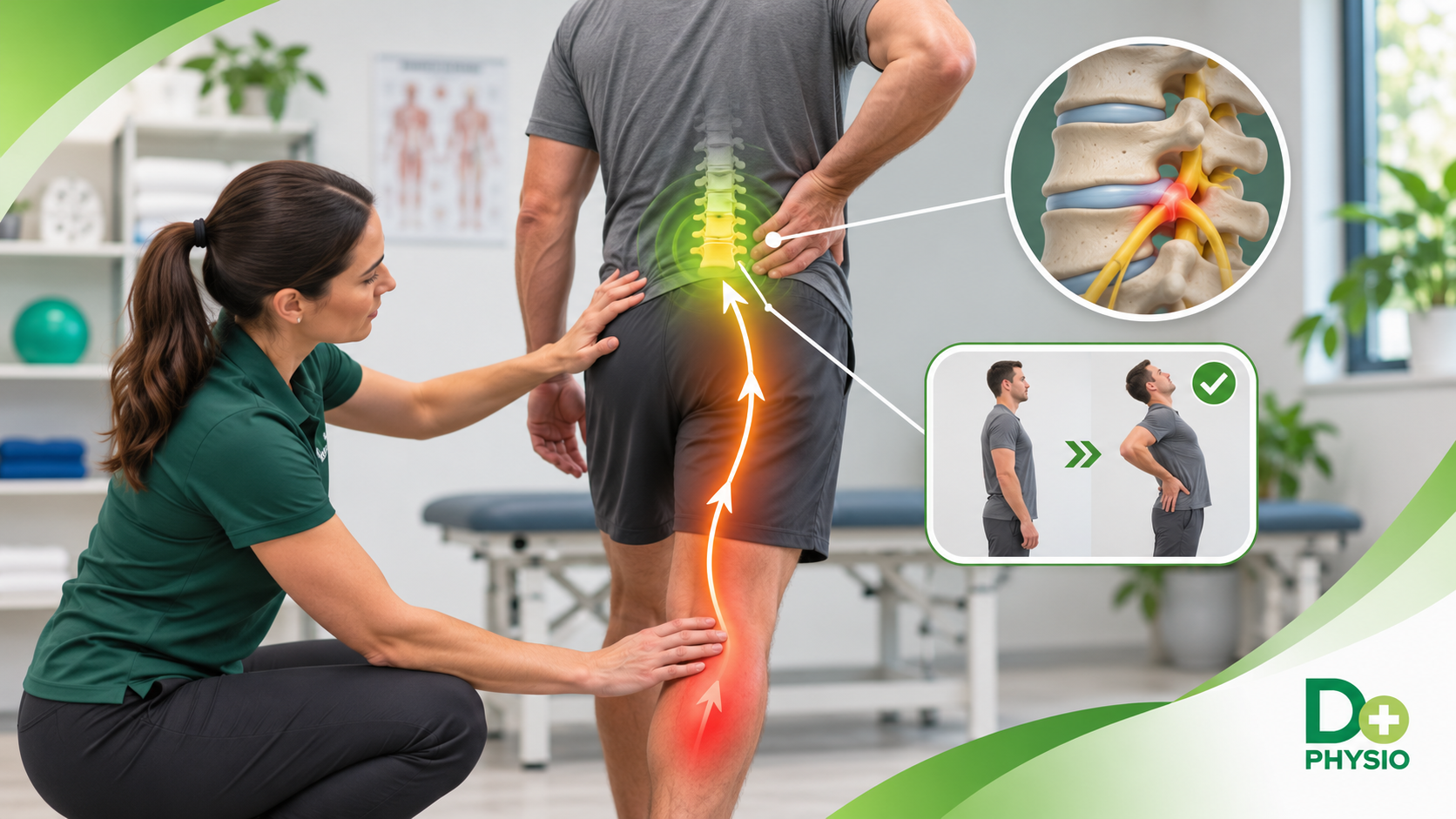
Patient Overview
Sometimes leg pain moves closer to the back during particular movements. This response, called centralisation, may help your physiotherapist choose suitable exercises. The best movement direction differs from person to person.
Clinical and Academic Discussion
During a spinal assessment, a patient may notice that pain previously felt in the calf moves towards the buttock or lower back after a series of movements. Although the back itself may still hurt, this change in symptom distribution can be clinically meaningful. It is known as centralisation and forms part of Mechanical Diagnosis and Therapy (MDT), commonly called the McKenzie Method.
What is centralisation?
Centralisation describes a lasting retreat of distal spinally related symptoms towards the spine in response to repeated movements or sustained positions. For example, pain in the foot may abolish while discomfort remains in the buttock or back. A temporary change while moving is not necessarily a true centralisation response; reassessment matters.
What is directional preference?
Directional preference refers to a direction of loading that produces a lasting improvement in symptoms or movement. Some patients respond favourably to extension, others to flexion or lateral movements. Centralisation can accompany directional preference, but a person may also demonstrate meaningful improvement without a change in pain distribution.
Does centralisation prove that a disc has moved back into place?
No. Centralisation is a clinical response, not direct evidence of disc repositioning. Proposed mechanical and neurophysiological mechanisms do not justify making a structural diagnosis from this response alone. Its value lies in helping classify symptom behaviour and guide subsequent management.
What is peripheralisation?
Peripheralisation refers to symptoms spreading further away from the spine in response to loading and persisting afterwards. This may indicate that the tested movement is not currently appropriate. The clinician considers the duration of the response, neurological status and overall presentation rather than assuming every temporary increase in symptoms is harmful.
What does the evidence say?
May and Aina (2012), and an updated review by May, Runge and Aina (2018), examined centralisation and directional preference as clinical findings. The updated review supports prognostic relevance particularly in low back pain; evidence is less consistent for neck pain and does not establish that these findings reliably identify which treatment will work best. A favourable response does not guarantee recovery or prove that one method is superior for everyone.
How is this used in physiotherapy?
A clinician first screens for serious pathology and evaluates neurological function where indicated. Repeated movement testing may then help identify a suitable loading strategy. A home programme can be selected according to the individual response and adjusted as function improves. The broader rehabilitation plan may also include graded strengthening, walking and education. Repeated lumbar extension is not a universal prescription.
Safety and the take-home message
Do not continue self-testing if leg weakness is worsening or symptoms deteriorate substantially. New bladder or bowel dysfunction, saddle numbness or rapidly progressive weakness requires emergency assessment. The aim of assessment is to identify a meaningful and reproducible response, not to force the spine in a predetermined direction.
References
May, S. & Aina, A. (2012). Centralization and directional preference: a systematic review. PubMed.
May, S., Runge, N. & Aina, A. (2018). Centralization and directional preference: An updated systematic review with synthesis of previous evidence. PubMed.
General educational information only. Individual assessment is recommended.
Literature and clinical content updated 25 November 2026. This is an educational resource, not a substitute for individual clinical assessment.