
Patient Overview
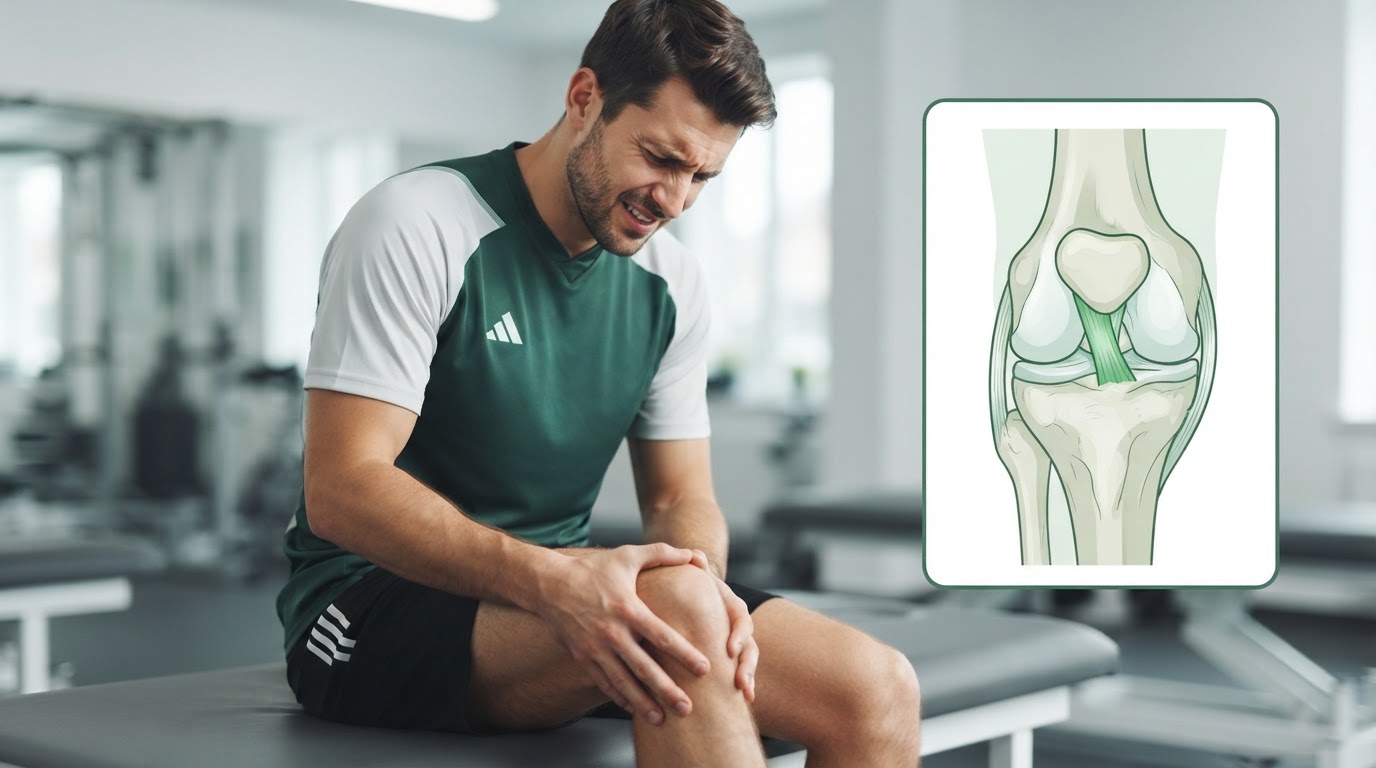
A sudden pivot, awkward landing or change of direction can injure the anterior cruciate ligament (ACL). A pop, rapid swelling and a feeling that the knee gives way are common clues, but not everyone experiences all three.
Anatomy and Mechanism
The ACL restrains anterior tibial translation and contributes to rotational stability. Associated meniscal, collateral ligament and cartilage injuries affect management. A large early effusion may represent haemarthrosis but is not specific to ACL injury.
Warning Signs and Immediate Management
Stop playing if the knee gives way. Use relative protection, compression and crutches if needed until assessed. Seek emergency care for deformity, a cold or numb foot, or severe trauma; prompt assessment is needed for a locked knee or inability to bear weight.
Clinical Assessment and Differential Diagnosis
Assess effusion, knee extension, quadriceps activation, gait and ligament integrity. Lachman testing is useful; pivot shift and anterior drawer contribute when tolerated. Acute guarding may limit testing. Radiographs are appropriate when fracture is suspected; MRI helps assess ligament and associated intra-articular injury.
Evidence and Clinical Guidelines
Rehabilitation-first management may be reasonable for selected patients with functional stability and compatible goals. Recurrent instability, high-demand pivoting sports and associated repairable injuries warrant orthopaedic consultation. Reconstruction is not automatically necessary for every tear.
Specific Rehabilitation Strategies
Initially restore full extension, manage effusion and rebuild quadriceps activation using supervised quadriceps contractions, straight-leg raises without lag and tolerated closed-chain exercises. Progress to loaded squats, step-ups, single-leg strength and neuromuscular control. After reconstruction, follow surgical restrictions, particularly with concurrent meniscal repair.
Return to Sport
Introduce running, jumping, landing and cutting in stages, guided by swelling, ROM, strength and movement quality. Assess quadriceps and hamstring strength, hop performance, confidence and sport exposure. A limb symmetry index of 90% is often used as one benchmark, not proof of readiness. Return to pivoting sport commonly takes many months after reconstruction; no date alone guarantees safety.
Monitoring and Prevention
Use IKDC and ACL-RSI alongside objective measures. Continue prevention training including landing mechanics, strength and change-of-direction control.
References and Further Reading
AAOS (2022). Management of Anterior Cruciate Ligament Injuries.
Aspetar clinical practice guideline on rehabilitation after ACL reconstruction (2023).
Educational information only. Rehabilitation and return-to-sport decisions require individual assessment.