
Patient Overview
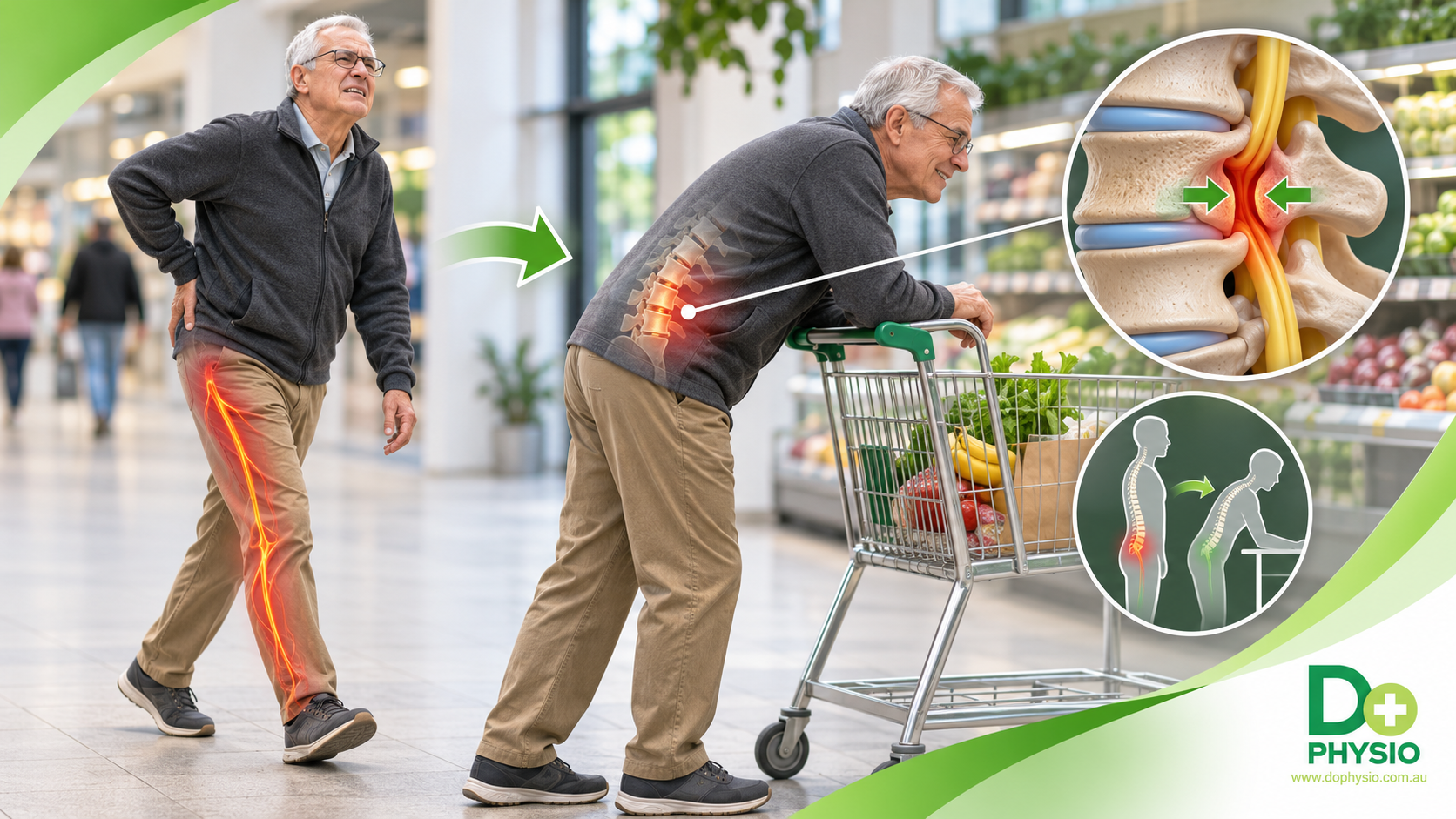
If standing or walking causes leg pain, heaviness or numbness that improves when you sit or lean forward, spinal stenosis may be one possible explanation. A physiotherapy assessment can help distinguish it from other causes, including circulation problems.
Clinical and Academic Discussion
Imagine walking through a shopping centre and finding that your legs become heavy, painful or numb after a few minutes. Sitting down or leaning over a shopping trolley brings relief. This pattern may suggest neurogenic claudication associated with lumbar spinal stenosis, rather than simply poor fitness.
What is lumbar spinal stenosis?
Stenosis describes narrowing of the spinal canal or spaces through which spinal nerves travel. Age-related disc changes, facet joint enlargement and thickening of the ligamentum flavum can contribute. The degree of narrowing on imaging does not necessarily predict how much disability a person experiences.
Why does bending forward help?
Lumbar flexion generally increases the available space within the spinal canal and neural foramina, whereas extension may reduce it. This helps explain why some patients tolerate cycling or sitting better than prolonged upright walking. Mechanical compression and changes in blood supply to neural tissues may both contribute to symptoms.
Neurogenic versus vascular claudication
Both conditions can cause exertional leg discomfort. Neurogenic claudication is often influenced by spinal posture, while vascular claudication may improve simply by stopping exercise, even without sitting. These patterns overlap, and peripheral arterial disease can coexist with spinal stenosis. Assessment of circulation, cardiovascular risk factors and neurological function is important.
How physiotherapists assess the condition
Assessment includes walking tolerance, symptom response to posture, lower limb strength, sensation, reflexes and functional mobility. Imaging may be appropriate when symptoms are persistent, the diagnosis is uncertain or specialist intervention is being considered. A scan alone is insufficient to establish symptomatic stenosis.
What does the evidence say about treatment?
Bussières et al. (2021) recommend considering multimodal non-surgical care incorporating education, exercise and rehabilitation. Ammendolia et al. (2022) found evidence supporting structured multimodal programmes involving manual therapy and exercise, with or without education. Treatment may include interval walking, cycling where tolerated, progressive lower limb strengthening and pacing. Flexion-based strategies can help selected patients, but should not be prescribed indiscriminately.
When is further medical assessment necessary?
Seek emergency assessment for new bladder or bowel dysfunction, saddle numbness or rapidly progressive leg weakness. Persistent disabling symptoms despite appropriate rehabilitation warrant medical review and possible spinal specialist referral. A suddenly cold, pale or painful limb also requires emergency assessment.
The take-home message
The goal is not simply to change the appearance of the spine on MRI. It is to improve walking capacity, independence and participation while monitoring neurological function.
References
Bussières et al. (2021). Non-Surgical Interventions for Lumbar Spinal Stenosis Leading To Neurogenic Claudication: A Clinical Practice Guideline. PubMed.
Ammendolia et al. (2022). Non-operative treatment for lumbar spinal stenosis with neurogenic claudication: an updated systematic review. PubMed.
General educational information only. Individual assessment is recommended.
Literature and clinical content updated 25 November 2026. This is an educational resource, not a substitute for individual clinical assessment.